
Why Portfolio Performance Is Now the MLS’s Most Strategic Advantage
The Stability Illusion.
For decades, MLS organizations lived in relative safety.
Dues revenue was predictable
Territories were stable
Competition was minimal or non-existent
That world is gone. Industry analysts, from Inman’s MLS Roundtable to T3 Sixty are sounding alarms:
“The MLS system is in jeopardy.”
“The MLS model faces an existential crisis.”
Meanwhile, external threats are multiplying:
Lawsuits threaten to reshape the market structure
National portals continue to dominate consumer mindshare
Private networks are poaching listing inventory
Venture-backed disruptors are redefining transaction workflows
Private equity is circling the edges of the MLS community
And member skepticism is quietly rising
But beneath all of this turmoil lies the most important (and most controllable) threat of all:
Members are questioning MLS value in ways the MLS hasn’t seen before.
Only 30% of an MLS’s product portfolio shapes 100% of the agent’s perceived value.
And what drives that perception more than anything else? Your product portfolio. The suite of tools your subscribers interact with every single day.
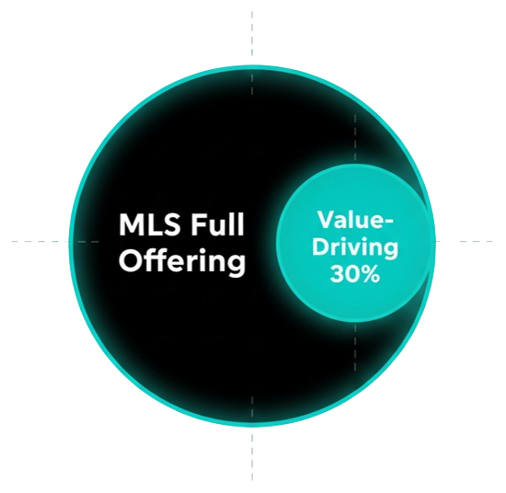
The part of the organization many MLS leaders treat as “secondary,” even though it shapes 100% of how members perceive the MLS. The MLS is no longer judged just by its rules or its database. It’s judged by its product experience. This white paper explains why and what MLS leaders must do next.
1. How the MLS Lost Its Clarity
There was a time when the MLS’s value was obvious. It was the marketplace of cooperation and the single source of truth for listings. It delivered exclusive access to data consumers couldn’t get anywhere else.
Then the world changed; a long time ago.
• Realtor.com opened to the public in 1996
• Zillow’s Zestimate arrived in 2006
• Consumers suddenly had access to most of what agents once paid for
And as MLS exclusivity faded, something else happened:
| “Member expectations began rising while MLS product strategy stayed largely the same.”
Agents started asking tough questions:
• “Why do we have so many tools we never use?”
• “What should I use from my MLS and what should I use from my brokerage?”
• “Why does this experience feel so fragmented?
• “What am I actually paying for?”
• “Why does every other real estate product I use feel more modern than the MLS?”
Instead of clarity, many MLSs now have:
• Redundant and/or overlapping tools
• Legacy systems (translated; really old)
• Vendor-driven portfolios that don’t necessarily reflect the local agent’s needs
• Confusing workflows, especially when the MLS and brokerage is looked at as a whole
• Adoption rates stuck at 10–20%
And members feel it.
2. External Threats Are Accelerating and All of Them Exploit the MLS’s Lack of Product Clarity
External pressures are coming from six major directions. And each one strikes harder when an MLS looks fragmented, outdated, and most importantly isn’t serving huge swaths of the value agents and brokers expect.

2.1 Technology-Driven Entrants
iBuyers, private brokerage ecosystems, and national portals are bypassing MLSs entirely. Opendoor, Offerpad, Compass, Zillow, and Redfin deliver integrated customer experiences at speeds most MLS simply haven’t matched. When agents see these environments, the MLS feels lacking by comparison, even if the core database is strong.
This is a product perception problem.
2.2 Private Listing Networks
Platforms like Compass are building parallel ecosystems that challenge MLS exclusivity. Lawsuits against NAR over Clear Cooperation signaled a real shift; agents are willing to bypass the MLS if they believe it limits them.
2.3 Legal and Regulatory Volatility
Antitrust suits targeting NWMLS, NAR, and MLS policies frame MLSs as rigid and anti-competitive. Even if the MLS wins legal battles, it risks losing something more important: goodwill. Product experience can counter that narrative better than policy statements ever will.
2.4 Growing Member Dissatisfaction
Surveys paint a clear picture:
• Agents increasingly question dues
• MLS tools are rated significantly lower than MLS data
• Satisfaction drops as user experiences grow more fragmented and/or confusing
• MLS value is increasingly seen as a “mandatory tax,” not a partnership
This is where the existential threat really lives. If members don’t see value, business models and revenue are at risk, not because of competitors, but because of perception.
2.5 Business Model Erosion
Agents and brokers are starting to have alternatives. The historic assumption of mandatory MLS participation is eroding. And when subscription becomes a choice, the MLS must compete on experience. This is where product strategy becomes existential.
3. The Most Undervalued Fix: Product Portfolio Clarity & Action
Most MLSs instinctively focus on:
• Compliance
• Data integrity
• Support
• Policy
• Governance
• Vendor management
Important? Absolutely. But these aren’t what members use every day. The single most powerful influence on member satisfaction is the product portfolio, which is the piece that quite often receives the least amount of attention. Here’s what decades of research show:
3.1 The Core Platform Is Table Stakes3.1 The Core Platform Is Table Stakes
Every MLS has a database. Every MLS enforces cooperation. Those aren’t differentiators anymore. They earn tolerance, not loyalty. Loyalty comes from:
• Thoughtful integration (SSO is table stakes)
• Tools that work together
• How tools fit an agent’s workflow
• Whether the experience feels modern/clean
• Whether members feel supported by the portfolio, not overwhelmed
• How well the MLS solves real needs and pain-points
| “The core platform earns tolerance, not loyalty”
Across WAV Group, T3 Sixty and other analyst’s research:
- Overall MLS satisfaction: 55–65%
- Satisfaction with MLS-provided tools: 40–50% (that’s generous considering adoption rates)
- MLSs that clarify needs and pain-points and adjust their product stack accordingly jump to 75–85% satisfaction
This is the biggest ROI lever an MLS controls.
3.3 Portfolio Perception Is Organizational Perception
Agents don’t distinguish between MLS and MLS vendors.
To them: The MLS is the product experience.
• If tools feel clumsy, the MLS is clumsy.
• If tools feel modern, the MLS is modern.
• If tools are overwhelming, the MLS is “disconnected from the needs of the business”
• If tools are connected and purposeful, the MLS is “a strategic partner.”
3.4 Product Strategy Is the Only Leverage Point MLSs Fully Control
You can’t control:
🚫 The lawsuits
🚫 The economy
🚫 National portal behavior
🚫 Federal regulation
But you can control:
✅ What tools you subscribe to
✅ How you partner with vendors to innovate and improve
✅ How you integrate tools
✅ What tools you retire
✅ How your members experience your portfolio
This is the fastest path to visible, measurable improvement.
4. Connecting the Dots: External Threats Amplify Internal Weaknesses Unless Portfolio Clarity & Action Fixes It
When you map external threats to internal levers, the pattern can be obvious or opaque, depending on the clarity you have around perceived value from your member community. However, you have to start with clarity.

• How does each primary cohort in your member community view MLS value?
• How does each tool in your portfolio measure up in that evaluation?
• What feature or tool gaps are present that would address real-world needs?
Product clarity doesn’t solve the problems, but it shines a bright light on them, and that’s exactly where you need to start. Without clarity from your member base, you’re playing darts blindfolded. With clarity, you can then develop a plan on how to address the problems and the mechanisms to measure success to ensure you’ve hit the mark.
5. Why MLSs End Up With Bloated, Confusing Portfolios
There are three recurring missteps that show up in many MLS approaches to portfolio problems:
1. “More Is Better”
Adding tools feels like adding value. That is until members feel overwhelmed and under-served.
2. “Training Will Fix It”
Training can’t fix tools that don’t solve real problems, or are poorly designed to do so. Adoption is rarely a training issue; it’s a product-strategy issue.
3. “We Know What They Need”
MLS leadership knows policy, rules, compliance, and local markets better than anyone. After all, that’s one of the primary jobs of the MLS leader. But member needs and pain points when it comes to product solutions are more nuanced. You only learn them through the various tools in the continuous discovery toolbox, not guesswork.
| “Adding tools feels like adding value. That is until members feel overwhelmed and under-served.”
6. The Shift MLSs Must Make: From Vendor Management to Product Management
Today’s MLS is not a database. It’s a technology platform. And that means MLSs must adopt the operating model of modern product organizations:
✅ Listen first – continuous discovery, not annual surveys
✅ Have a product strategy – which should align with and support corporate strategy
✅ Align every product to member needs – not vendor pressure or board preference
✅ Simplify intentionally – fewer or different tools, positioned more clearly
✅ Retire the laggards – quietly and in a member-supportive manner
✅ Evolve constantly – because agent needs are shifting constantly
This is the new MLS competency. The product portfolio has the highest visibility and the highest return on effort. Treat it that way. Doing so improves:
• Satisfaction (20–40% lift)
• Perceived relevance
• Renewal resilience
• Organizational credibility
• Competitive insulation
• Member trust
If disruption is the storm, portfolio clarity and action is the umbrella.
Conclusion: Adaptation Starts Inside
The MLSs that will thrive in the next decade won’t be the ones with the largest databases or the best compliance function. They’ll be the ones whose product ecosystems feel:
• Modern
• Integrated
• Purposeful
• Role-specific
• Connected to daily agent reality